
There was a time when the goal of filler was simple: add volume. But today, patients are more sophisticated. The focus has shifted toward precision, balance, and refinement. Sometimes that means adding filler. Sometimes it means removing or adjusting filler first.
At Mabrie Facial Institute in San Francisco, dissolving filler is not viewed as a failure. It is often the first step in creating a more natural, balanced result.
When Filler Needs a Reset
Not all filler settles perfectly. Over time, certain patterns can develop that soften your natural facial contours or create shapes that feel less refined.
Here are a few common examples where dissolving filler can help restore natural structure before refining the result.
Loss of Vermilion Border Definition
The vermilion border is the crisp edge where the pink lip meets the surrounding skin. It creates the natural frame of the lips. When filler is placed too superficially or spreads into this area, the border can become blurred.
Patients may notice:
- Lipstick bleeding past the lip edge
- Lips looking puffy but lacking definition
- The upper lip appearing wider without a clear outline
As you can see in our example below, carefully dissolving a small amount of filler can restore the natural lip edge before we refine the shape.

The “Duck Lip”
Another pattern occurs when filler accumulates in the central portion of the upper lip. This creates a peaked or shelf-like appearance called the “Simpson effect.”
Instead of a smooth, natural contour, the lip may develop:
- A pointed center
- Uneven fullness across the lip
- An unnatural profile
Strategic dissolving can restore a smoother lip contour and allow for more balanced reshaping. Our next patient’s lips looked too “outlined” from the side, so our correction focused on creating a cleaner edge and improving lip proportion.

A Blue Tint Under the Eyes (Tyndall Effect)
When filler sits too close to the surface, light scattering can create a bluish hue beneath the eyes known as the Tyndall effect.
Patients often describe:
- A blue or gray tint under the eyes
- Filler looking more visible in certain lighting
- Puffiness rather than a smooth transition from eyelid to cheek
In these cases, dissolving the superficial filler allows the area to return to its natural baseline before more precise treatment. The photos below show strategic refinement creates a smoother, lighter, and more uniform under-eye appearance.

“Wait, Doesn’t Filler Just Dissolve on Its Own?”
One common misconception is that filler simply disappears over time. While many hyaluronic acid fillers gradually break down, they often persist longer than patients expect, especially in areas with less movement.
Over time, filler may:
- Soften
- Shift slightly within the tissue
- Accumulate after repeated treatments
When this happens, dissolving filler with hyaluronidase can reset the area and allow for more precise refinement.
Filler Dissolving Before and After: What Better Actually Looks Like
Correcting Previous Lip Filler
While this patient preferred a more plump and rounded lip aesthetic, she felt her results from another clinic left her overfilled with filler outside the natural lip line. Using Hylenex, we targeted the overfilled areas that had contributed to the lack of well-defined contour to rebalance her look.

Correcting Previous Under Eye Filler
Incorrectly placed fillers, particularly under the eyes, can unfortunately highlight issues like puffiness, dark circles, and a sunken look. In this case, Dr. Mabrie achieved a more natural and rejuvenated appearance by skillfully dissolving the improperly placed filler, followed by careful reapplication of HA filler.

Correcting Previous Filler in Multiple Areas
This patient’s treatment plan focused on dissolving previous filler, followed by precise re-treatment to restore natural contour and brightness under the eyes. We helped the midface and under-eye area appear smoother and less heavy—an important reminder of why we rarely treat features in isolation.

How Do You Dissolve Filler?
Dissolving filler involves using an enzyme called hyaluronidase, which breaks down hyaluronic acid fillers.
When injected into the area containing filler, the enzyme helps the body naturally metabolize the product, allowing the tissue to return closer to its original state.
At Mabrie Facial Institute, dissolving is performed with a precise, targeted approach, focusing only on the areas where adjustment is needed.
Not all fillers are dissolvable. RADIESSE® and Sculptra® are resorbable (biodegradable), non-HA injectable treatments. They can’t be instantly reversed the way HA fillers can, but the body will still gradually break them down over time.
Why More Patients Are Choosing To Dissolve Filler in 2026
Patients dissolve filler to restore clean definition when the filler has lasted longer than expected, softened a border, or changed how light reflects on camera.
Common reasons driving the rise in filler correction include:
- The aesthetic has shifted. Definition, proportion, and natural facial movement matter more than “more volume.”
- Patients are better educated. The Tyndall effect, under-eye irregularities, and lip border distortion are now widely recognized.
- Long-term planning is becoming more important than the moment. More patients are seeking a plan that accounts for what is already in the face, not just what they want added next.
- Filler removal is now seen as refinement, not a failure. Filler correction is now being understood as part of a larger treatment strategy.
And perhaps the biggest shift: the old idea that HA filler will simply dissolve on its own over a short timeframe has been challenged by newer imaging insights and clinical observation. The practical takeaway is this: if filler is creating a shape problem, waiting rarely improves it.
When Dissolving Is the Right Move
Dissolving filler isn’t reserved for “complications.” In many cases, patients have a specific cosmetic goal in mind: they want their lips to look defined again, their under eyes to look smoother on camera, or their cheeks to stop casting heaviness where they want light.
Signs of Misplaced Filler
- A blue or gray tint in the under-eye area (the Tyndall effect)
- Puffiness that is worse in the morning and improves after being upright for a few hours. This can happen when superficial filler attracts fluid while you are lying flat.
- A blurred lip border or thickness above the vermillion edge
- Loss of lip definition, where the Cupid’s bow and philtral columns (the two vertical ridges above the upper lip) soften instead of sharpen; when too much filler is injected into the white of the lip, this can lead to the “Simpson effect” or “Bart Simpson deformity.”
- Cheek fullness that creates under-eye heaviness, changing how light reflects beneath the eyes
- “It looked fine at first, then it changed.” Early swelling can mask an irregularity. Once swelling settles, the underlying contour issue becomes easier to see.
Dissolving is rarely treated as an all-or-nothing event at MFI. In many cases, we find that the best result comes from removing a few millimeters, restoring clean transitions, and keeping structural elements that are still doing their job.
What Happens During a Dissolving Appointment at MFI
Dissolving appointments start with seeing the full picture of your face and understanding your filler history. During your appointment, you can expect:
1. Consultation and Aesthetic Mapping
We start with the part that’s often missing elsewhere: context.
- Your best available filler history (what was used, where, and when).
- Standardized photos and facial assessment to identify patterns:
- Placement too close to an edge
- Product sitting too superficially
- Imbalance between under-eye filler and midface support
- Clear goals for the visit:
- Refine – micro-adjust a specific issue
- Reset – remove enough filler to re-plan
- Rebuild – set the foundation for a staged contour plan, including our i360 Full Face treatment
2. Precisely Targeted Hylenex Injections
This is the most important idea in dissolving: More enzyme does not equal better technique. We use strategic micro-injections to maintain control and reduce the chance of overcorrection.
Our Injectors tailor their approach depending on:
- Facial region
- Filler depth
- Tissue compartment
- How long the filler has been present
- The specific product formulation
3. Initial Recovery
Many patients notice softening of fullness or contour within hours, but the “final read” takes a little longer.
- Same day: You may notice the area looks less full or more even.
- First night/next morning: Swelling can look more pronounced when you wake up, especially around the lips and under-eye area.
- First 24 to 48 hours: Avoid judging symmetry too early, as swelling peaks.
- 48 hours: You will have a more reliable look at your results.
4. Planned Follow-Up (If Necessary)
Strategic follow-up appointments help us confirm precision, especially when filler history is layered, records are incomplete, or product behavior is unpredictable.
Two realities guide our planning:
- Depth alignment is everything. The enzyme needs to meet the filler in the correct tissue plane.
- Not all hyaluronic acid fillers behave the same. Some fillers break down quickly; others respond more slowly and are best refined in stages.
5. Retreatment
The timing for your filler treatment depends on your goal and tissue response. Many patients can be retreated once swelling has settled, and the result is stable—often in 1 to 2 weeks for small refinements, and closer to 2 to 4+ weeks for more complex corrections or sensitive areas like the under eyes.
- If we are refining, follow-up confirms precision and protects against overcorrection.
- If we are resetting, we balance tissue recovery with your next-step contour plan.
- If we are rebuilding, we sequence treatment using Illumination 360° planning: structure first, then careful enhancement once your initial results have been revealed.
Why Some Fillers Dissolve Faster Than Others
When we talk about how easily a filler dissolves, we’re referring to two things: the in vitro guidance and relative susceptibility. The former is what researchers observe in controlled lab conditions, and the latter is the practical, real-world tendency of one HA filler to respond more readily to hyaluronidase than another.
Relative Susceptibility of HA Fillers to Hyaluronidase
| Filler Family | Technology | Susceptibility |
|---|---|---|
| Original Restylane® | NASHA | Highest susceptibility |
| JUVÉDERM® Ultra and Ultra Plus XC | Hylacross | Moderate susceptibility |
| RHA® Collection | PNT | Moderate to lower susceptibility |
| JUVÉDERM® Vycross Collection | Vycross | Lowest susceptibility |
Different HA formulas exist because they do different jobs. Some are designed to integrate softly, others to hold structure longer, and others to refine edges with a lighter touch. Susceptibility to hyaluronidase is simply one variable in a much bigger decision—alongside anatomy, depth, tissue quality, and long-term planning.
Do You Need Ultrasound To Dissolve Filler?
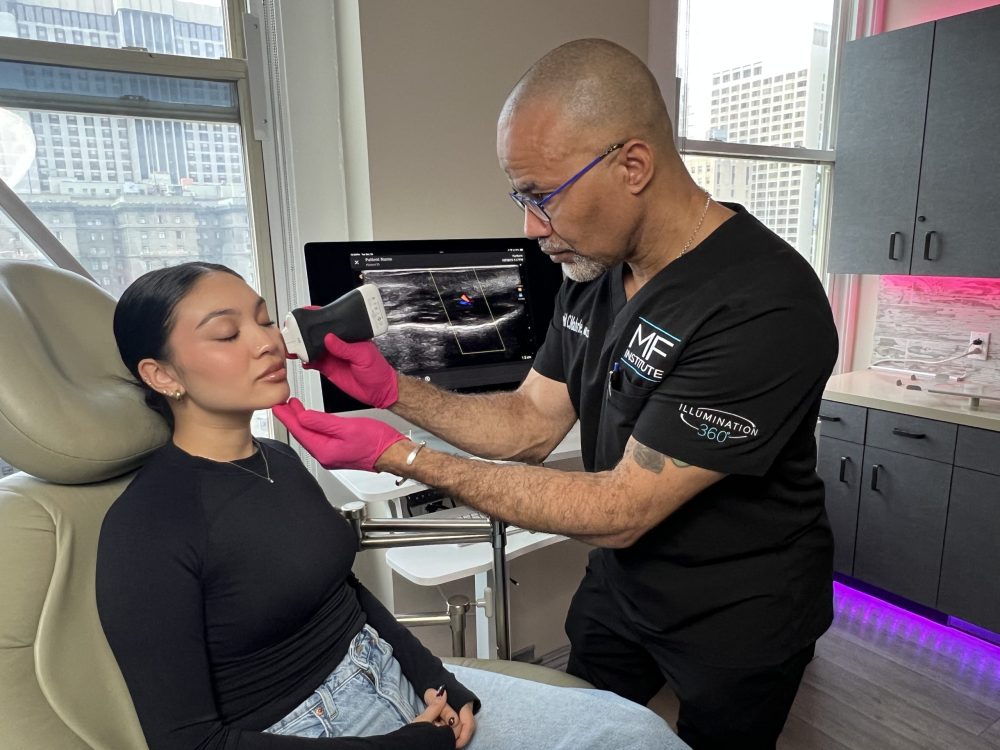
Ultrasound-guided filler dissolution can be helpful, but it’s not automatically required. It can be a meaningful option for patients whose:
- Filler was placed deep
- Filler type is unknown
- Treatment area has a higher vascular risk
- Prior dissolving attempt did not change the contour as expected (suggesting a depth mismatch)
Ultrasound guidance may not be helpful when:
- The issue is clearly superficial and consistent with a known pattern, such as the Tyndall effect beneath the eyes.
- The filler location and depth are clinically obvious based on anatomy, imaging, and response patterns.
- The goal is a small, targeted refinement rather than a complex search.
We only recommend ultrasound when it improves clarity and safety for your specific case. The outcome still depends on technique, depth control, and judgment.
The MFI Difference: Strategic Retreatment
Dissolving works best when it is part of a sequence. Too often, med spas take a “flood and forget” approach, treating dissolving as a single event and hoping the contour lands where it should. This is where our experience and expertise shine through.
Our Illumination 360° philosophy offers full-face insights to ensure every correction and new filler addition works in harmony. We stage our approach to protect proportion and keep options for intentional rebuilding.
Risks, Safety, and Why Experience Matters
Dissolving filler is a medical procedure. It should be treated like one.
What Inexperienced Providers Often Miss
- Not all filler is HA. Non-HA fillers cannot be dissolved with hyaluronidase.
- Over-dissolving is possible. Chasing perfection in one visit can create hollowing or collapse.
- Depth mismatches limit results. If dissolving is performed at the wrong depth, the filler can remain.
- Delayed swelling exists. A small subset of patients can develop a delayed immune-type swelling response after filler.
- Old recommendations were not always optimal. Older training often encouraged using softer fillers in a superficial layer to reduce the risk of a blue tint. At MFI, we’ve found that delicate areas usually do better with thoughtful product selection and deeper placement, which can create cleaner contours and more even light reflection.
Why Filler Problems Happen in the First Place
Our Injectors commonly trace filler issues to a few root causes:
- Filler placed in a suboptimal location or at an incorrect depth
- Delayed swelling; This is a rare late reaction (affecting roughly 1% of patients per year) that can cause swelling long after the original treatment.
- Uneven persistence across areas, especially where under-eye filler remains while the midface support is lost over time. In these cases, restoring the sunken midface and cheek areas can improve the overall appearance.
Does Hyaluronidase Dissolve Your Natural Tissue?
No. When used correctly, hyaluronidase is designed to break down hyaluronic acid filler, not “melt” your skin or facial structures (e.g., fat, muscle, connective tissue).
This fear usually comes from a reasonable misunderstanding: Your body naturally contains hyaluronic acid, so it sounds like hyaluronidase could dissolve everything. In practice, treatment is highly targeted for precise refinement, not widespread change.
We use a controlled approach with careful mapping, conservative dosing, and planned follow-up when needed. This strategy keeps dissolving measured and predictable, especially in sensitive areas like the lips and under eyes.
Dissolving Filler FAQ
How does dissolving filler work?
We use an enzyme called hyaluronidase (Hylenex) to break down the hyaluronic acid gel so your body can absorb it. Your result depends on accurate placement at the correct depth and the specific filler characteristics.
How quickly does Hylenex work?
Many patients see softening of the existing filler within hours, but it can take weeks for the filler to break down completely. In some cases, you may need a follow-up treatment.
Do you always need ultrasound-guided filler dissolving?
Not always. Ultrasound can be helpful when the depth is uncertain, filler type is unknown, vascular risk is higher, or previous attempts did not produce the desired results. In straightforward superficial patterns, it may not add meaningful value, especially when working with an experienced Injector.
Can you dissolve under-eye filler safely?
Yes, but it requires careful technique and an advanced understanding of facial anatomy. The under-eye tissue is thin and reactive, which is exactly why dissolving should be controlled and, when needed, staged.
How many sessions does dissolving lip filler take?
It depends on how much lip filler is present, whether it is layered, where it sits relative to the vermilion border, and how resistant the filler is to hyaluronidase. Some patients need one refinement visit, while others benefit from a staged approach to avoid overcorrection.
What if my filler isn’t hyaluronic acid?
If the filler is non-HA, Hylenex will not be able to remove it; however, it may biodegrade naturally over time, as is the case with Sculptra and RADIESSE.
A Smarter Reset Starts Here
Dissolving filler is less about erasing the past and more about restoring control when filler has been placed at the wrong depth, too close to an edge, or layered without a long-term sequence. For many patients, a small, targeted adjustment is enough to bring back definition and improve balance.
If you’d like to discuss whether dissolving filler is the right refinement step for you, request a consultation online or call Mabrie Facial Institute at (415) 445-9513 to get started today.
Leave a Reply