

When Filler Doesn’t Go as Planned
Sometimes it’s too much volume. Sometimes it’s a product placed in the wrong spot or a result that just doesn’t look like you anymore. For many patients, the harder part isn’t what they see in the mirror. It’s what they carry with them: the embarrassment, the worry, or the sense that this might just be how things are now.


You’re Not the Only One Who Feels Stuck
Entire online communities have formed around people seeking help for disappointing filler results because so many people are living through this exact same experience. These virtual spaces may offer real comfort, but they can also spread confusing, conflicting, or simply incorrect information about how to safely correct filler.
Much of the misinformation surrounds the use of hyaluronidase (Hylenex®), the injectable enzyme used to dissolve hyaluronic acid-based fillers like JUVÉDERM® or Restylane®. As a result, many people feel overwhelmed or resigned to “waiting it out.”
Often, this distress comes down to one question:
“Am I stuck like this?”
Common Myths About Dissolving Filler


Contrary to popular belief, filler correction is still possible, even if your injections happened years ago or a previous attempt to dissolve didn’t go the way you hoped. If you’ve been looking for answers online and aren’t sure who to trust, we’re here to set the record straight.
#1. Hyaluronidase will damage my skin.
A common patient fear is that hyaluronidase will not only dissolve the filler but also the hyaluronic acid naturally present in the skin. While it is true that the enzyme doesn’t distinguish between the two, the effect on your body’s own HA is temporary and localized, since your skin continuously replenishes it. Filler, by contrast, is designed to resist that same breakdown and requires direct, deliberate contact to dissolve.
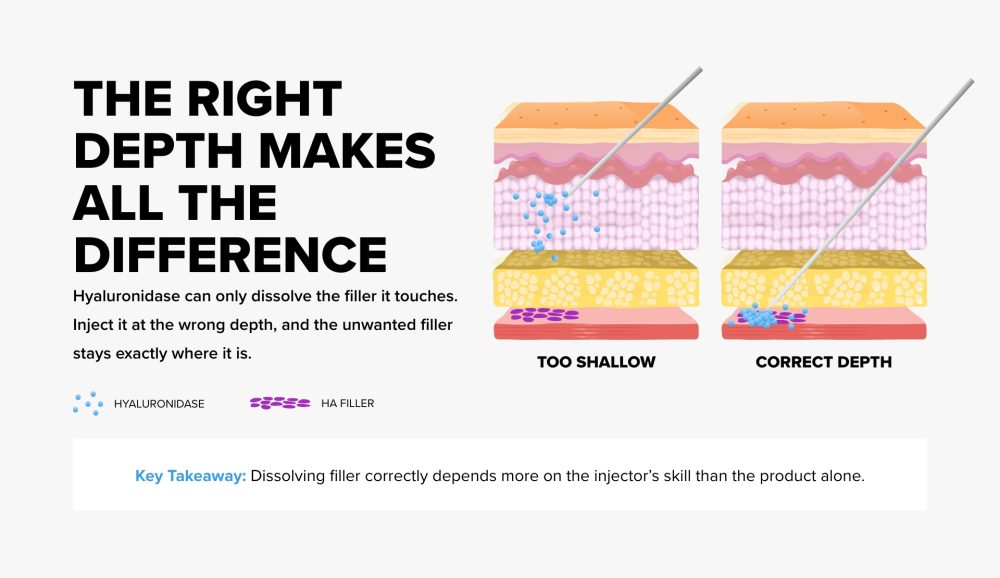
Hylenex may be the most effective product available for dissolving HA filler, but the product alone doesn’t guarantee a good outcome. In the wrong or inexperienced hands, even the best tool has its limits, especially when the enzyme is placed in the wrong tissue plane.
Placed too superficially, the correction may be incomplete because it never reaches the filler sitting lower in the tissues. Placed too deeply, it can affect the surrounding tissue beyond where the correction is actually needed.
The key to a successful result isn’t just precision placement. It’s the knowledge, experience, and clinical judgment that comes with it.
#2. My filler was placed so long ago it must be gone.
Many patients are told that filler lasts 6 to 18 months, depending on the specific formulation, so it’s natural to assume that anything placed years ago couldn’t still be affecting how you look today. However, HA filler can persist far longer than once believed. One review of MRI studies identified detectable filler more than 15 years after the last injection in some patients.
Filler placed years ago may still be contributing to:
- Under eye puffiness
- Facial fullness
- Widening of the face
- Loss of natural contours
If any of this sounds familiar—or if you would like to start fresh—our Illumination 360°® Facial Analysis can determine whether dissolving is the right next step.
#3. I tried dissolving, and it didn’t work for me.
When a corrective treatment doesn’t produce the change you expect, it’s easy to assume the filler simply can’t be removed. In reality, this is a signal that your treatment needs a different approach: a more experienced injector, a fuller reassessment of exactly where the filler sits, or a second attempt based on how the filler responded to the first session.
For some patients, multiple sessions may be needed to achieve the best results! If your face requires deeper or more significant filler correction, don’t give up. With patience and a skilled injector, you can get back to baseline.
#4. I should just wait for my filler to fade away.
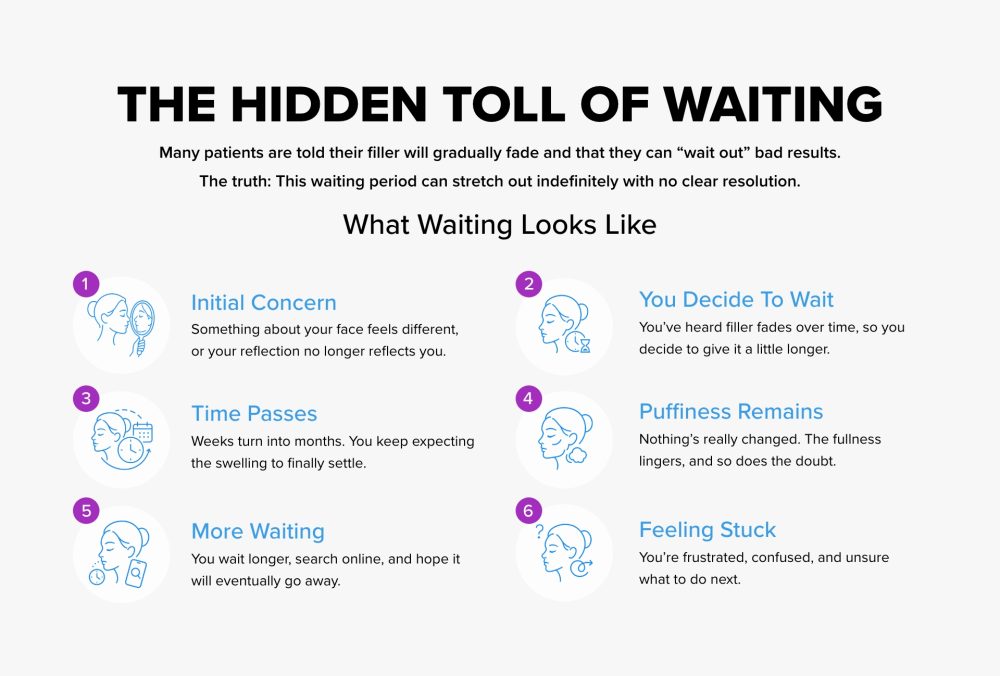
Waiting can feel like the safer choice if you aren’t sure how—or whether—to proceed with filler dissolving. But waiting isn’t actually neutral.
It doesn’t undo your concerns, and it doesn’t get you any closer to results you’re happy with. It just delays a decision that’s still there to be made.
Rather than asking, “How long should I wait for my filler to go away?” ask yourself, “Is filler still contributing to what I’m seeing?” If the answer is yes, we invite you to come in for a consultation to discuss the next steps.
Why Filler Correction Doesn’t Always Work
After disappointing results, several different injectors, or a dissolving attempt that didn’t fully work, it’s easy to conclude that filler just doesn’t work for you. But poor results rarely mean filler was the wrong treatment—and an unsuccessful dissolving attempt doesn’t mean the filler can’t be removed.
More often, the real culprit is improper placement, a lack of cohesive treatment planning, or an inexperienced injector. Whatever brings you to MFI, our i360 Correct treatment is designed to give you a better path forward.
The i360 Correct Approach to Filler Correction


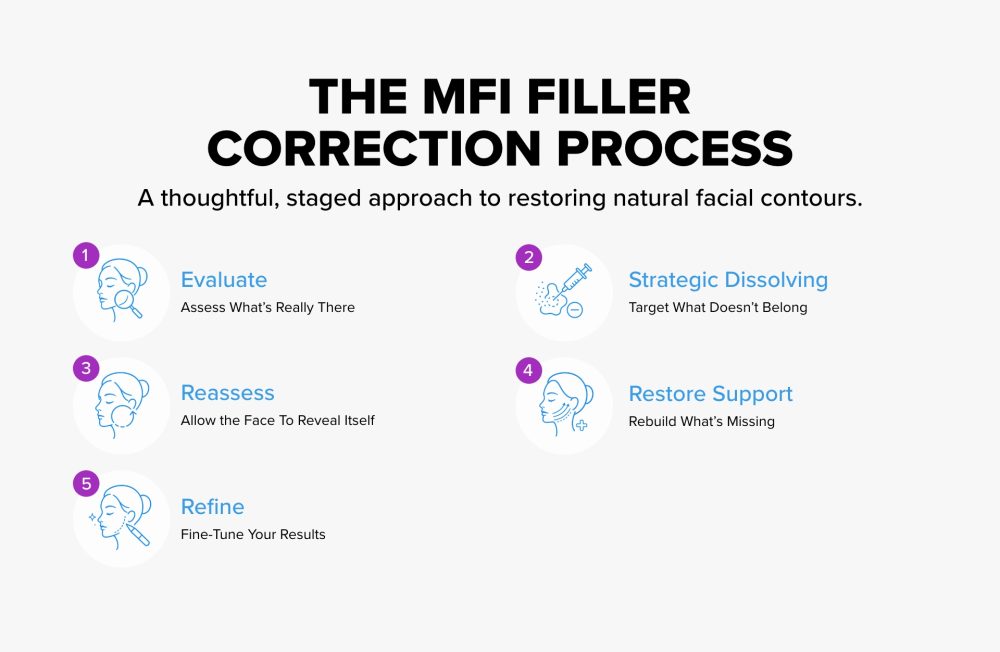
Filler correction at MFI begins with a careful assessment of your existing filler and facial structure, followed by strategic dissolving and reassessment before rebuilding whatever support your face may be missing.
Each stage exists for a reason. Dissolving without a plan for what comes next can leave a face looking hollow or unsupported. Rebuilding too early, before excess filler is fully addressed, can mean layering new correction on top of the very problem you came in to fix. This thoughtful sequencing—knowing not only what to correct but when—is where technical skill becomes genuine expertise.
Stage 1: Evaluate
What is actually causing the concern?
We assess your facial anatomy and get a more complete picture of your filler history. Our Illumination 360° Facial Analysis reveals areas of excess fullness and those lacking support. We document your baseline with photographs and discuss your treatment goals.
Stage 2: Dissolve
What should be removed?
We determine the correct tissue plane for injection and begin to dissolve the unwanted filler, paying close attention to the natural structure of your face. While we can make significant improvements in a single session, many patients need more than one treatment to remove the filler completely.
Stage 3: Reassess
What are we truly working with?
After waiting for your tissues to settle, we bring you in for a follow-up evaluation. We take new photographs and identify what—if anything—is still left to address before moving into another corrective session or retreating the area with filler.
Stage 4: Restore
What support is missing?
Once your face is ready for new filler, we start recreating any lost facial support and addressing areas of volume loss. We work conservatively to avoid overfilling, focusing on enhancing contour and overall balance.
Stage 5: Refine
How do we make you look like you again?
Like your hyaluronidase injections, filler is completed over 2 or more sessions for the best results. This intentional waiting period (usually 6 weeks) allows your face to settle and gives us a clearer picture for the next steps. This refinement appointment fine-tunes your results for optimal contour and harmony.
Our Expertise in Action
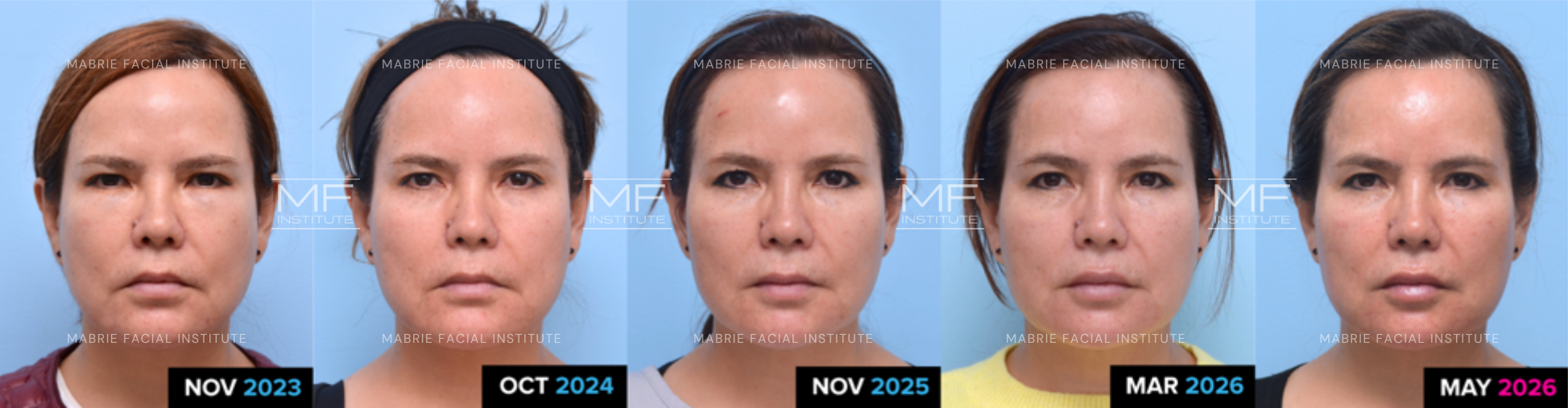
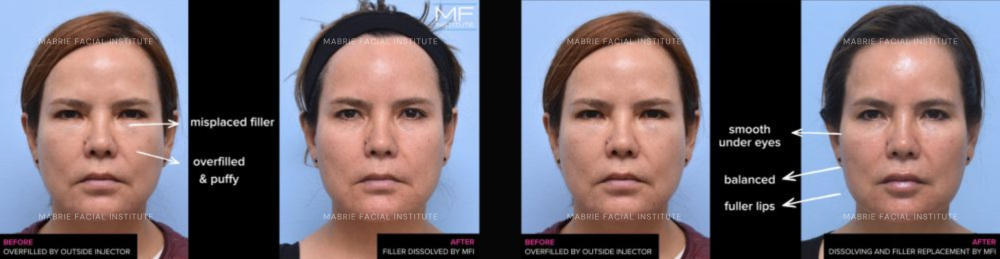
This patient came to us after years of filler treatments performed elsewhere, unhappy with the fullness and puffiness that had developed over time. During her Illumination 360° Facial Analysis, we examined her face closely to identify the root causes of her concerns: improper filler placement, overfilling, and filler stacked on top of older layers.
What We Did
Her correction and retreatment unfolded across multiple sessions. We began by dissolving the excess product that was creating the heavy, pillowy look in her mid and lower face. We then added support and contour to bring her face back into balance and to create a more defined facial shape.
Our patient’s under eyes are now smoother and brighter, her cheekbones “pop” more, and her jawline and chin now taper to a flattering V-shape. Subtle refinement to her lips added the finishing touch.
Are You a Candidate for i360 Correct?
You may be a good candidate for filler correction if:
- You’ve had unsatisfactory filler treatments in the past
- You’re not sure if what you’re seeing now is normal or something worth addressing
- You’ve considered dissolving but aren’t sure where to start
- You want to (finally) get the results you deserve and love
If any of this sounds like you, an Illumination 360˚ Facial Analysis can determine whether i360 Correct is the right next step for you.
Final Thoughts
Filler placement and correction are two of the most technique-dependent procedures in aesthetic medicine. If you’re unhappy with the results of past filler treatment, a skilled injector may be able to achieve a better outcome than you thought was possible.
If you’re still weighing your options or ready to take the next step, we’re here to help. Request a consultation or call Mabrie Facial Institute at (415) 445-9513 to get started.
Leave a Reply