

What’s Going On?
You had filler placed months ago, maybe even a year or two ago. You’d almost forgotten about it. Then one morning, you wake up and something looks different. The area feels fuller, maybe a little firm, maybe slightly tender. You didn’t bump it, you didn’t have a new treatment, and you certainly didn’t expect this.
If this has happened to you, take a breath. What you’re describing has a name—delayed swelling—and while it can be surprising, it’s uncommon, usually temporary, and almost always very manageable.
How Common Is It?
Delayed swelling after hyaluronic acid (HA) filler is uncommon. A meta-analysis of 28 published studies found it occurs in about 1% of treatments on average, although the exact rate varies depending on the specific filler used.
Emerging research also suggests that delayed swelling rates may vary by skin tone and ethnicity, making it important to work with a provider who specializes in treating patients with diverse skin tones and ethnic backgrounds.
While the overwhelming majority of filler patients never experience delayed swelling, if you’re one of the few who have, it helps enormously to understand why it happens.
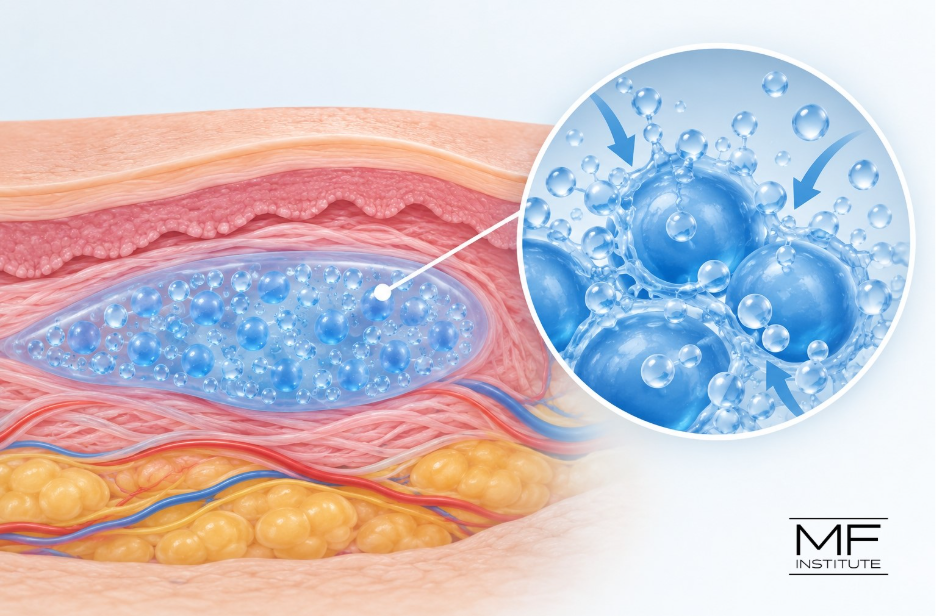
Why Does Delayed Swelling Happen?
Many patients don’t realize that modern HA fillers can persist in facial tissue much longer than expected—sometimes, years past the point where patients assumed it had fully dissolved.
That’s actually the key to this whole phenomenon. If filler is still present, however subtly, it remains something that your body can occasionally react to.
The good news is that delayed swelling often has identifiable causes, even when it feels unexplainable at the time.
Simple Water Retention
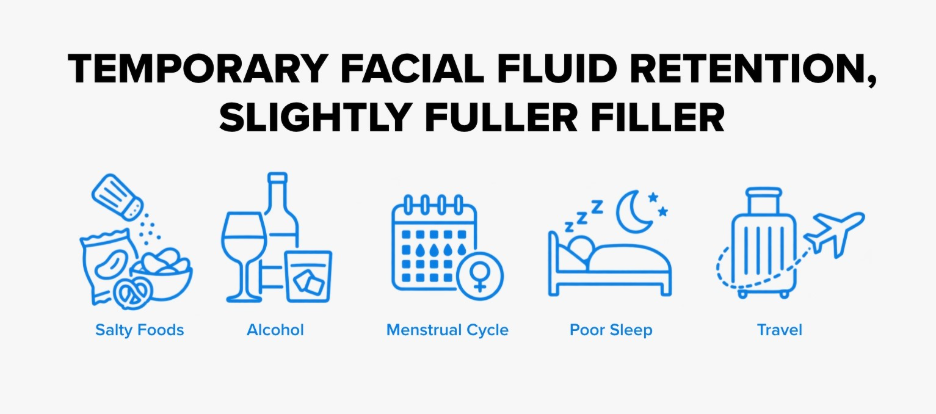
HA filler is hydrophilic, meaning it naturally attracts and holds onto water. That’s actually part of what makes it work so well for creating soft, natural volume. But it also means the filler can temporarily draw in a little extra fluid when your body is retaining water for unrelated reasons, such as your menstrual cycle, a salty meal, alcohol, poor sleep, or travel.
This water retention isn’t a complication at all. It’s just your filler doing what hydrophilic gel does, and it settles back down on its own.
Immune System Activation

Anything that revs up your immune system can, in rare cases, cause temporary inflammation around filler that has otherwise been sitting quietly for months or years. Common triggers include a viral illness, an upper respiratory infection, a stomach bug, dental work or a dental infection, a sinus infection, and, notably, a COVID-19 infection or vaccination.
COVID-19 is actually part of how physicians came to understand this phenomenon more clearly, since the wave of infections and vaccinations in recent years made these reactions easier to observe and study. In these cases, your immune system briefly treats the filler as something worth reacting to, causing swelling that then resolves as the underlying trigger passes.

What If There’s No Clear Reason?
Occasionally, delayed swelling happens without any identifiable trigger at all. There’s no infection, illness, or obvious cause. This can be the hardest answer to hear, but it’s an honest one, and it doesn’t change the fact that these cases typically resolve just as well as the others.
What Delayed Swelling Usually Looks Like
Typical delayed swelling tends to involve mild to moderate fullness, some firmness, and mild tenderness, located exactly where your filler was originally placed. It generally does not involve severe pain, skin discoloration, or symptoms that keep getting worse.
If you are experiencing severe pain, skin discoloration, or worsening symptoms, that’s a reason to get evaluated for other causes, such as vascular occlusion, rather than assuming it’s ordinary delayed swelling.
When Should I Call My Injector?
Most cases of delayed swelling are mild and don’t require a call at all. Here’s how to know when it’s worth reaching out.

Green: Likely Fine, Just Keep Watching
Mild swelling that improves day by day and resembles what you experienced after your original treatment.

Yellow: Worth a Call
Swelling that lasts longer than several days or keeps coming back.

Red: Seek Evaluation Promptly
Severe pain, skin turning pale or purple, or symptoms that are rapidly getting worse. These aren’t typical of ordinary delayed swelling and deserve a closer look.
Common Misconceptions About Delayed Filler Swelling
Delayed swelling comes with more than its share of assumptions. Let’s separate some common myths from what’s actually true.
Myth #1. If my filler swelled a year later, something must have gone wrong.
Not usually. Delayed swelling can happen even when the filler was placed correctly and everything went as planned.
Myth #2. My filler must have migrated.
Most of the time, the filler hasn’t actually moved. It has simply absorbed extra water or become temporarily inflamed in place.
Myth #3. My filler should have completely disappeared by now.
Modern HA fillers frequently last far longer than patients expect, which is exactly why delayed swelling can occur months or even years after treatment.
Myth #4. If it’s swelling, it has to be dissolved.
Not usually. Most episodes resolve on their own without dissolving anything at all. Dissolving only comes into play when swelling won’t settle down or keeps returning.
How Delayed Swelling After Filler Is Treated
Treatment follows a step-by-step approach, starting with the least invasive option:
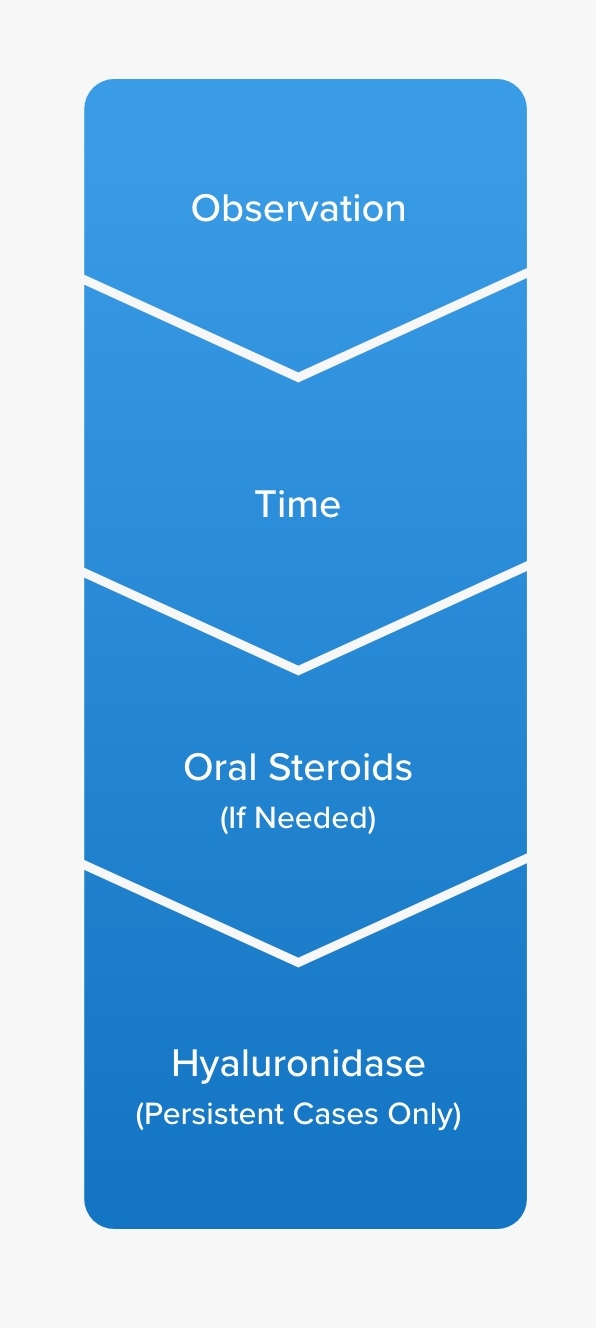
Observation and Time
Most cases improve on their own within several days without any intervention.
Anti-inflammatory Treatment
If swelling is persistent, a short course of oral corticosteroids can often resolve it.
Hyaluronidase
Dissolving filler with hyaluronidase is reserved for cases that are persistent, recurrent, or particularly bothersome. Treatment, however, doesn’t always mean dissolving all of your filler.
Sometimes, only a small amount needs to be dissolved to calm things down. In other cases, more of the filler is dissolved and then thoughtfully replaced once the inflammation has fully resolved. Either way, this isn’t an all-or-nothing decision, and it’s not one you have to make alone.
Will Delayed Swelling Happen Again?
Having one episode of delayed filler swelling doesn’t mean you’re likely to have another. Many patients go through it once, resolve it, and never experience it again.
The Bottom Line
Delayed swelling can be unsettling, especially when it shows up months or years after you’d stopped thinking about your filler at all. Most patients recover with nothing more than a little time and observation, while the small number who need treatment respond well to medical management or a selective, thoughtful use of hyaluronidase.
If you’re experiencing swelling and aren’t sure whether it’s something to watch or something to call about, getting evaluated is usually a quick, reassuring process. We’re here to help you recognize what’s happening, rule out anything more serious, and treat it with the least aggressive approach necessary. Request a consultation using the online form or call Mabrie Facial Institute at (415) 445-9513 to get started.

Leave a Reply